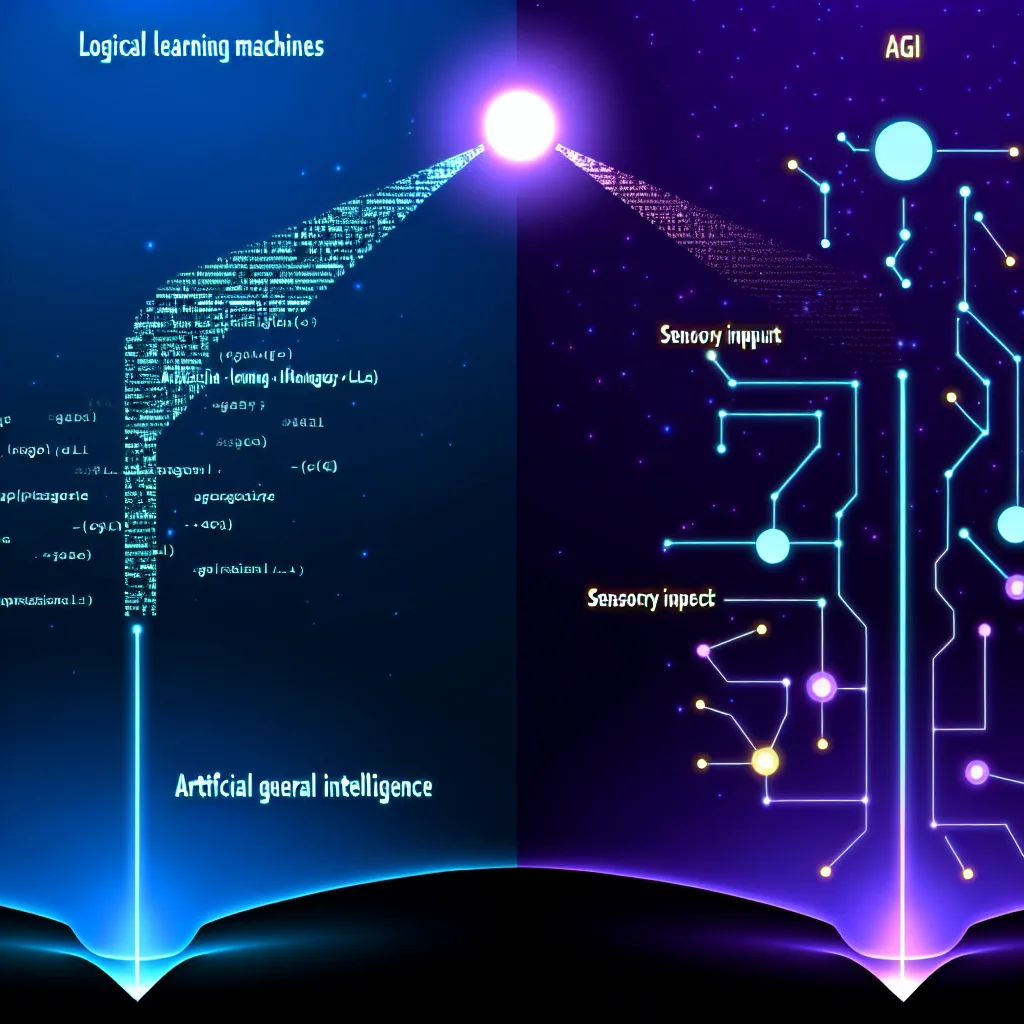
Are large language models the final step, or just a stepping stone? Two of AI’s godfathers have thoughts on the matter.
It feels like we’re on the edge of something massive with AI, doesn’t it? Every week, there’s a new model that can write, code, or create images that feel impossibly human. It’s easy to look at things like ChatGPT and wonder if we’re just one big update away from true Artificial General Intelligence (AGI). But is the LLM path to AGI really that straightforward? It turns out, the people who built this field have some strong, and fascinatingly different, opinions on the matter. Specifically, two of the three “Godfathers of AI,” Yann LeCun and Geoffrey Hinton, offer a glimpse into the debate at the very highest level.
Yann LeCun’s Core Argument: LLMs Don’t Understand the World
Yann LeCun, currently the Chief AI Scientist at Meta, has been pretty vocal about his skepticism. His view, in a nutshell, is that Large Language Models, for all their linguistic talent, are fundamentally limited. They are masters of predicting the next word in a sentence, but they don’t possess a real, underlying understanding of the world.
Think about it like this: an LLM can write a beautiful paragraph about a glass falling off a table. It knows the words “gravity,” “shatter,” and “spill.” But it doesn’t have an intuitive grasp of physics. It has never seen a glass fall. It has no internal “world model” to simulate what would happen.
LeCun argues that this is the missing piece. He believes that for an AI to achieve human-level intelligence, it needs to be able to learn from and build models of reality, much like animals and humans do. He often points out that a huge amount of human knowledge is non-linguistic. As he stated in an interview with ZDNet, “most of human knowledge has nothing to do with language… so that’s why this idea of AGI-through-language is a dead end.” He champions for AI architectures that can learn and reason about the world through more than just text.
Geoffrey Hinton’s Evolving View on the LLM Path to AGI
This is where the conversation gets really interesting. Geoffrey Hinton, who left his role at Google to speak more freely about the risks of AI, has a more nuanced and evolving perspective. For a long time, the consensus was that we’d need a major breakthrough beyond the current technology. But Hinton has admitted he’s been stunned by the emergent abilities of recent, scaled-up LLMs.
He suggests that these models might actually be learning more about reality than we give them credit for. In a landmark interview with MIT Technology Review, Hinton explained that while LLMs learn from text, the text itself is a reflection of human perception and understanding of the world. By learning the relationships between words, the models are indirectly learning about the concepts they represent.
So, does he think the LLM path to AGI is the final answer? Not exactly. While he’s more optimistic than LeCun about the potential within LLMs, his main focus has shifted to the immense danger they pose. He believes they are already powerful enough to be used for manipulation and creating a world where we can “no longer know what is true.” His concern is less about whether we can get to AGI with these models and more about whether we should be racing to do so without fully understanding how to control them.
So, Do They Really Disagree?
On the surface, it looks like a clear disagreement. LeCun says LLMs are a dead end for AGI; Hinton says they’re surprisingly potent and maybe even on the right track. But if you dig a little deeper, their positions are closer than they seem.
- They both agree: Today’s LLMs are not AGI.
- Where they differ is the “how”: LeCun believes a fundamental architectural change is necessary. We need to build systems that can perceive and model the world directly. Hinton seems to believe that the existing transformer architecture might be more powerful than we imagined, and scaling it further could unlock more surprising capabilities, but that this path is fraught with existential risk.
It’s like two architects looking at a skyscraper. LeCun is on the ground, saying, “This foundation will never support a building tall enough to reach the moon; we need to invent anti-gravity technology.” Hinton is in a helicopter halfway up, saying, “I am shocked this thing is already in the clouds, and it’s still going. It might actually get us there, but it’s swaying so much I’m terrified it’s going to collapse and destroy the city.”
The conversation isn’t really about whether LLMs are impressive; it’s about their ultimate ceiling and the safety of the journey. For anyone interested in the future of artificial intelligence, it’s a critical discussion. As we stand here in late 2025, the debate continues, reminding us that we are still in the very early days of this new era. The path forward is unwritten, and even the pioneers who drew the map aren’t sure where it leads.
For a broader overview of the AGI concept, the Wikipedia page on Artificial General Intelligence is a great starting point.